

Search

School of Drama Alumnus Koo
Jaha Receives International Ibsen Award
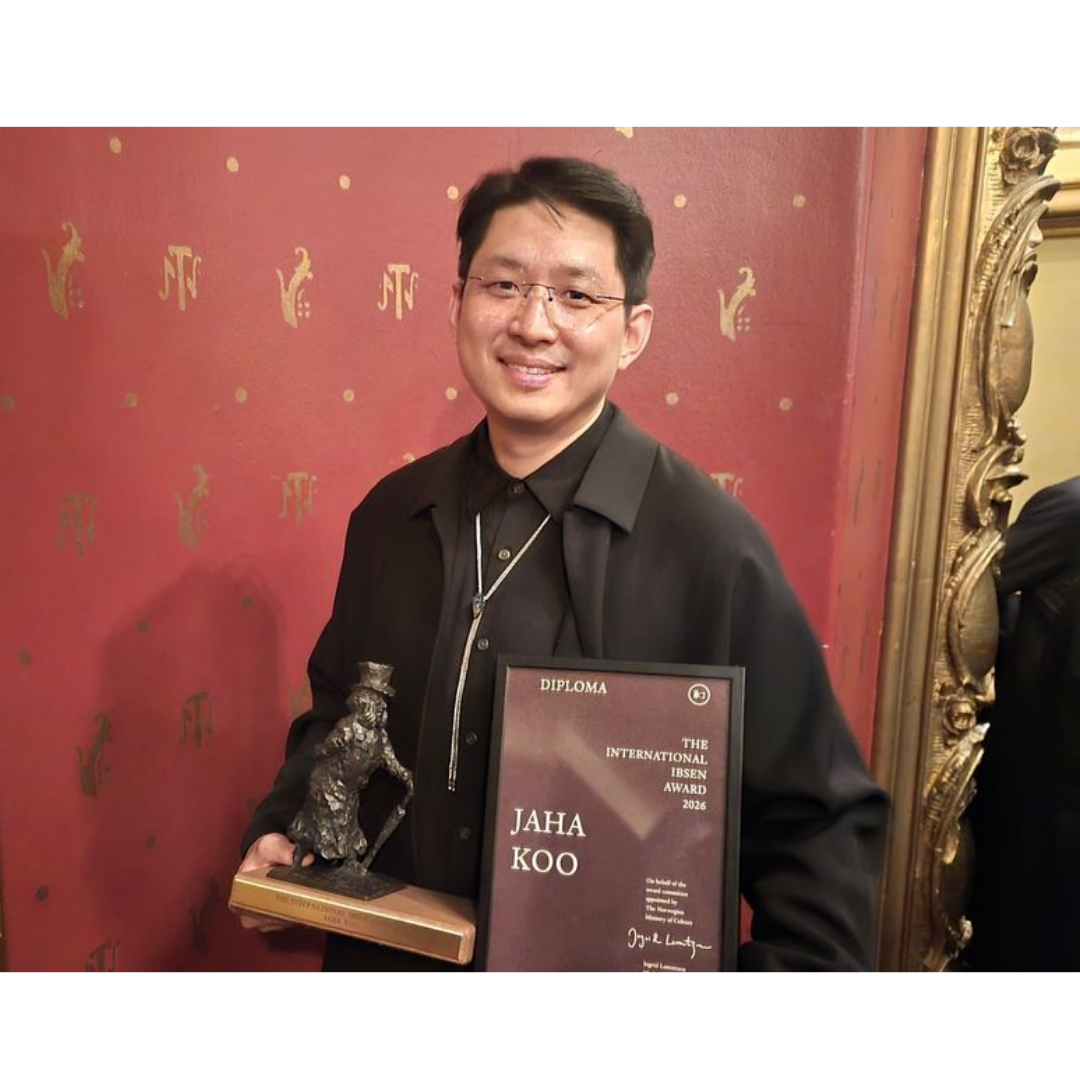
Theater artist Koo Jaha, an alumnus of the School of Drama, has received the prestigious 2026 International Ibsen Award. At 42, he is the youngest recipient in the award’s history and the first artist of Asian descent to receive the honor, which is widely regarded as one of the world’s most distinguished prizes in theatre.
Koo accepted
the award and its 2.5 million Norwegian kroner prize—approximately 358 million
Korean won—at a ceremony held at the National Theatre in Oslo, Norway, on
September 26. He received the honor before an audience of approximately 700
people, following his initial announcement as the 2026 laureate back in March.
Established by
the Norwegian government in 2007 to honor the legacy of Norwegian playwright
Henrik Ibsen (1828–1906), the International Ibsen Award was presented annually
until 2010 before shifting to a biennial cycle. Unlike awards that evaluate a
single production or season, the International Ibsen Award recognizes an artist
or company’s overall body of work and profound artistic contribution.
Koo studied Theatre Studies at K-Arts and later earned a master’s degree in contemporary theatre from the Amsterdam University of the Arts in 2016. Working dynamically as a theatre maker, director, composer, and video artist, he has forged a distinctive theatrical language that weaves together music, video, text, and robotic objects across multimedia and technological performances.
This year’s jury recognized Koo’s unique ability to conceive of theatre as an "in-between space" in "a world too often divided into for and against"—a space where people can gather, imagine, and draw inspiration from the unknown. Ingrid Lorentzen, chair of the jury and Artistic Director of the Norwegian National Ballet, praised Koo’s capacity to transcend ideological and conventional boundaries in theatre and performance arts.
In his
acceptance speech, Koo shared that he has continually strived to avoid creating
theatre that remains trapped in the past and disconnected from contemporary
sensibilities. He explained that his persistent questioning of theatre—rather
than affection for it alone—has been the driving force behind his creative
journey, adding that he will continue to ask what theatre should be and who
deserves to stand on stage.