

Search

School of Visual Arts
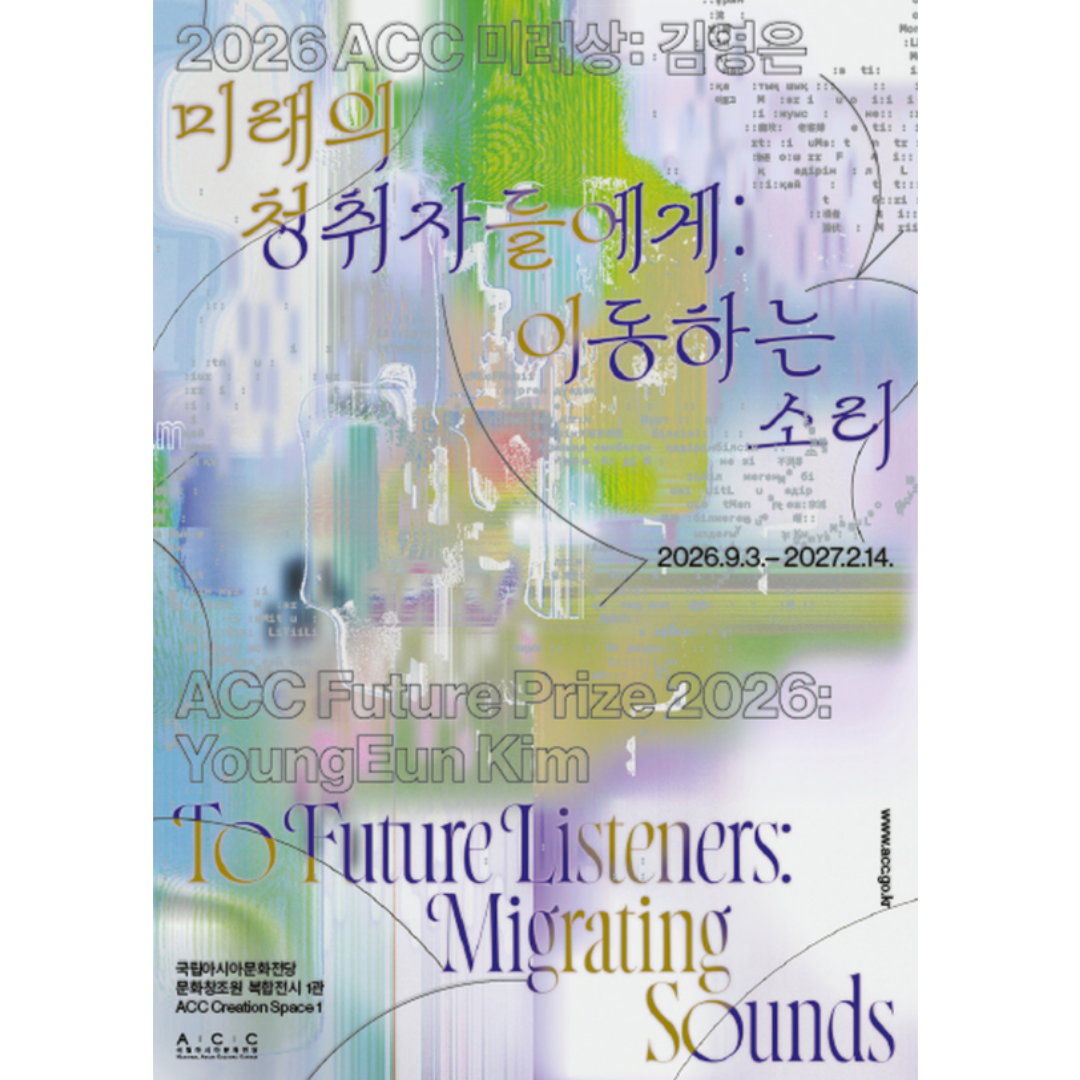
Alumna Kim Youngeun Presents To Future Listeners: Migrating Sound
Kim Youngeun, an alumna of the School of
Visual Arts, is presenting To Future Listeners: Migrating Sound at the National
Asian Culture Center (ACC). The exhibition runs from September 3, 2026, through
February 14, 2027.
This exhibition is the winning project of
the ACC Future Prize 2026, an interdisciplinary arts award presented by the ACC
and the Ministry of Culture, Sports, and Tourism with production support. Kim
received the award last year and was subsequently selected as a finalist for
the prestigious 2025 Korea Artist Prize, drawing significant attention from the
visual arts community.
The large-scale installation occupies a massive exhibition hall measuring 25 meters in width, 60 meters in length, and 15 meters in height. A total of 115 speakers are installed across the ceiling and floor to create an immersive soundscape. The work combines an Ambisonics speaker system with a Wave Field Synthesis (WFS) system, which accurately reproduces sound waves from virtual sources and allows sound to travel through the space in three dimensions. As visitors move through the exhibition, they can physically experience shifting distances, directions, and elevations of sound. Meanwhile, three large screens positioned at the front and on both sides of the hall display words and fragments that hint at the poems, languages, and stories underlying the sounds.
The sound works draw upon nine Asian poems
from the 8th to the 20th centuries that deal with themes of colonial violence,
war, separation, migration, and displacement. To recover the pronunciation and
recitation styles of voices that once transmitted these histories but have
since disappeared, Kim conducted extensive archival research, consulted
specialists, and collaborated with composers who had migrated to the regions
where the respective languages are spoken.
Among the nine works is a revised version
of Lament of an Old Refuge Woman by Heo Gyun, which portrays an elderly woman
wandering in the aftermath of the Imjin War. The nine works are presented as an
approximately 60-minute program played continuously throughout the exhibition.
For over two decades, Kim has explored
forgotten voices and narratives overlooked by visually dominant accounts of
history. In this exhibition, she once again champions the primacy of sound,
stating that above all else, the one thing she hopes to leave behind through
her work is the sound itself.